
Commercial Roofing in Newbury Park, Thousand Oaks, CA
Request a Newbury Park roof condition review
Newbury Park
A roof call in Newbury Park needs two clear answers: where water is getting in, and what work will stop it without opening more of the assembly than necessary. We start with the roof itself. Before setting a repair scope, we identify the membrane or metal system, mark drains and low points, and trace the reported leak toward seams, curbs, penetrations, walls, and edges. Newbury Park is a district within Thousand Oaks, not a separate city in our service description. Ventura County’s Thousand Oaks Area Plan provides a framework for nearby unincorporated growth areas; a parcel’s planning status belongs with the property team. Our roofing recommendation comes from field conditions at that property.

Set the inspection boundary before the roof walk
We confirm who can authorize access, how the crew reaches the roof, and whether ladders, hatches, lifts, or tie-off points are available. The inspection record should say where access stopped. If equipment, a fragile surface, or a restricted area prevents a full view, we mark the gap instead of treating an unseen section as clear.
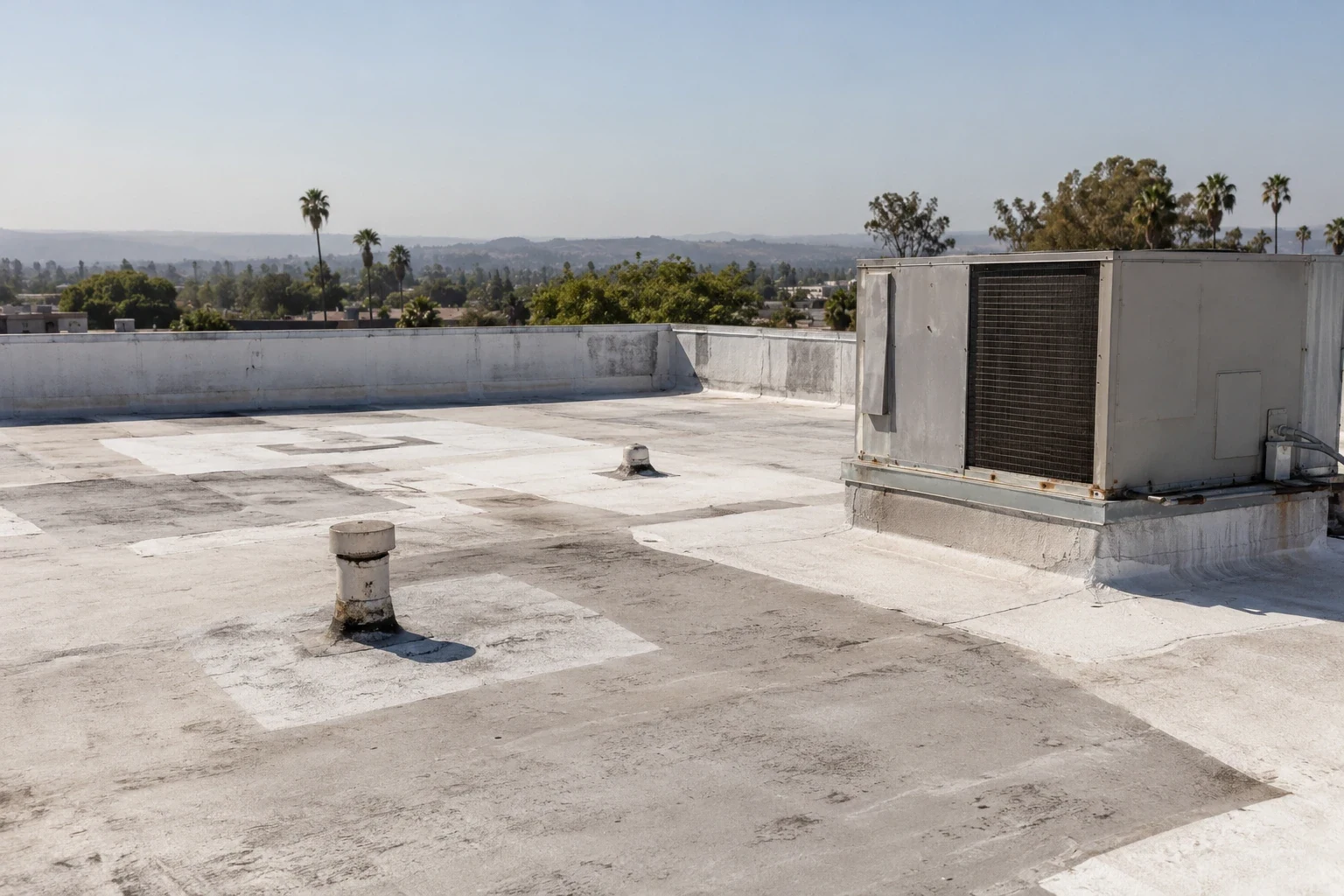
Once access is set, we divide a large roof into sections that can be located again. Each photo gets a roof area or nearby reference point. We check the field membrane, transitions, penetrations, parapets, perimeter metal, and previous patches, recording open seams, punctures, loose terminations, wear, and visible water marks. A stain inside Newbury Park does not pinpoint its roof entry. We compare its location and timing with the details above and explain what additional testing would establish. A commercial roof inspection documents condition beyond the leak response.
Follow water to the detail that failed
At every drain or scupper, we look at the opening, surrounding membrane, connection, and overflow path. We note debris and restrictions, but clearing an outlet does not prove that it caused the leak. Water can travel below the surface before appearing inside. At a wall or curb, we check the flashing height, corners, seal, and termination. On a low-slope area, we record standing water and compare it with slope, outlet position, and any visible movement.
Oxnard’s weather station recorded 1.77 inches during Tropical Storm Hilary in August 2023, its highest August monthly amount in that station’s record. That is a dated reading for Oxnard, not a Newbury Park rainfall measurement. For a Newbury Park property, we use its own drainage layout and leak history to set the inspection. If the outlet connection is open, drain and scupper repair can address that detail. If water remains, we investigate before recommending ponding-water repair.
When moisture may extend beyond what the surface shows, we describe a test area and what the result would change. A small number of test openings can distinguish wet insulation from an isolated seam defect. The estimate defines that boundary and separates concealed conditions from findings.
Close seams, curbs, and wall transitions
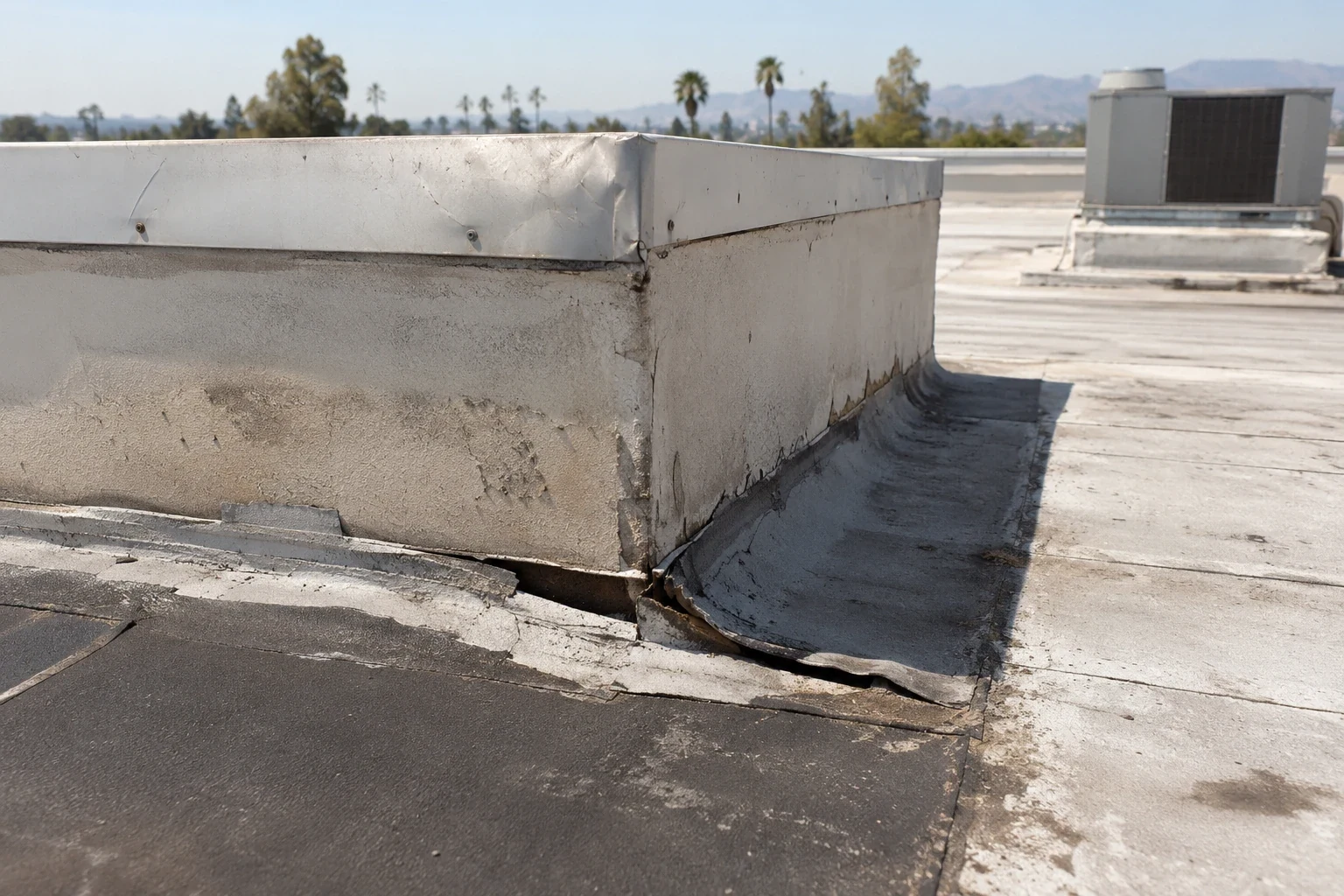
A repair succeeds at its edges. We remove loose or incompatible material back to a stable boundary, prepare the surface for the identified roof system, and tie the repair into sound material. At a curb, we inspect corners and the connection to the field membrane. At a wall, we follow the flashing to its termination. At a seam, we check for movement or failed adhesion along more than the visible opening.
Materials vary by assembly. Thermoplastic seams need a clean, weldable surface; EPDM, modified bitumen, coated surfaces, and metal details call for compatible methods. We identify the system before selecting a patch, and look for a repeated cause such as movement, standing water, or an earlier repair that did not bond. Seam repair addresses a split or failed lap, while flashing repair restores a transition. If equipment work affects the detail, the scope assigns responsibility for disconnecting or moving it and establishes when the roof can be closed.
For an urgent leak, the first visit may use a temporary measure to limit water entry. We label temporary protection and document the permanent repair and any remaining follow-up.
Compare a repair with broader roof work
A targeted repair is reasonable when the defect is localized and the surrounding roof can accept a durable tie-in. Where openings recur, moisture spans several areas, attachment has loosened, or the deck may be affected, patching each symptom can leave the underlying problem in place. We document the evidence and compare a defined repair with a larger section or replacement scope. A commercial repair scope should show its quantities, limits, access assumptions, and exclusions.
A recover or overlay is not automatically the economical choice. Existing layers, moisture, drainage, edge height, penetrations, and project requirements can change whether another assembly is suitable. We inspect those conditions and separate known quantities from concealed work. If a replacement is under consideration, we explain phasing, tear-off, dry-in, protection below, and how roof access may affect daily operations.
For planning, Ventura County’s Thousand Oaks Area Plan covers nearby unincorporated growth areas, and Newbury Park appears in Port Hueneme’s regional worker-home analysis. Those sources do not establish a particular building’s roof type or maintenance history.
Make the findings useful after the crew leaves
A property manager often needs a record that can travel from a leak call to a capital discussion. We organize photos by roof section, label observed conditions, list repairs completed, and identify any area that still needs testing. We compare viable options and state what remains uncertain.
We also note practical constraints that change sequencing: occupied spaces below, access windows, equipment coordination, staging, and the point at which the roof is watertight at day’s end. These details belong in the work plan because they affect scheduling and protection. For a portfolio spanning Newbury Park, Simi Valley, and Thousand Oaks, consistent roof maps and condition notes help compare buildings while preserving the distinct findings at each address.
Our photo-backed roof condition reports connect each recommendation to field evidence. Reports distinguish monitor items from repairs.
Build the estimate around access and quantities
Price depends on the measured repair area, roof system, preparation, material compatibility, access, protection, and whether investigation reveals wet insulation or damaged deck. A quote based only on a leak description has no reliable way to account for those conditions. We first inspect the location, then state what is included and what would require approval as concealed work. When a small test opening is appropriate, its purpose and repair method are described before it is made.
Schedule also depends on roof access, weather exposure, material lead time, tenant coordination, and any equipment shutdown. We identify the sequence and the surface that must remain protected each day. If a temporary stabilization is needed before a permanent repair, we separate the immediate step from the final scope.
For recurring defects, we compare the cost of repeating a local patch with the documented area that may need broader work. That comparison uses quantities and condition evidence, not a blanket rule. The scope lists assumptions and exclusions for bid comparison.
Related Roofing Work
More from Service Areas and nearby services
Request a Newbury Park roof condition review
Share the roof plan, leak history, access instructions, equipment schedule, and prior repair notes. We will document the affected roof areas and explain the repair choices, assumptions, and next steps.
Common Questions
Is Newbury Park a separate municipality for this service-area page?
We describe Newbury Park as a district within Thousand Oaks. Ventura County’s Thousand Oaks Area Plan provides a framework for nearby unincorporated areas, while the property team confirms the parcel’s applicable planning status.
Can a ceiling stain identify the roof defect?
No. Water may travel before it appears indoors. We compare the stain’s timing and location with roof seams, drains, penetrations, and transitions, then explain whether testing is needed to confirm the path.
What should the roof report include?
It should identify inspected areas, access limits, observed conditions, photos, completed work, and unresolved questions. We distinguish a confirmed defect from a suspected cause and tie each recommendation to a roof section.
When is a temporary leak repair enough?
Temporary protection can limit entry while permanent work is planned, but it does not establish that the assembly is dry or sound. We label it temporary and define any inspection or repair that remains.
What information helps price a commercial roof repair?
Roof plans, leak history, access instructions, equipment details, and prior repair records help. We still verify the assembly and measure the affected area before setting quantities and separating concealed conditions.